
Zenodo 論文:https://doi.org/10.5281/zenodo.18095626
Description
This paper is a policy–research position paper based on:
Konishi, H. (2025), Structural Inducements for Hallucination in Large Language Models (V4.1),
Zenodo. DOI: https://doi.org/10.5281/zenodo.17720178
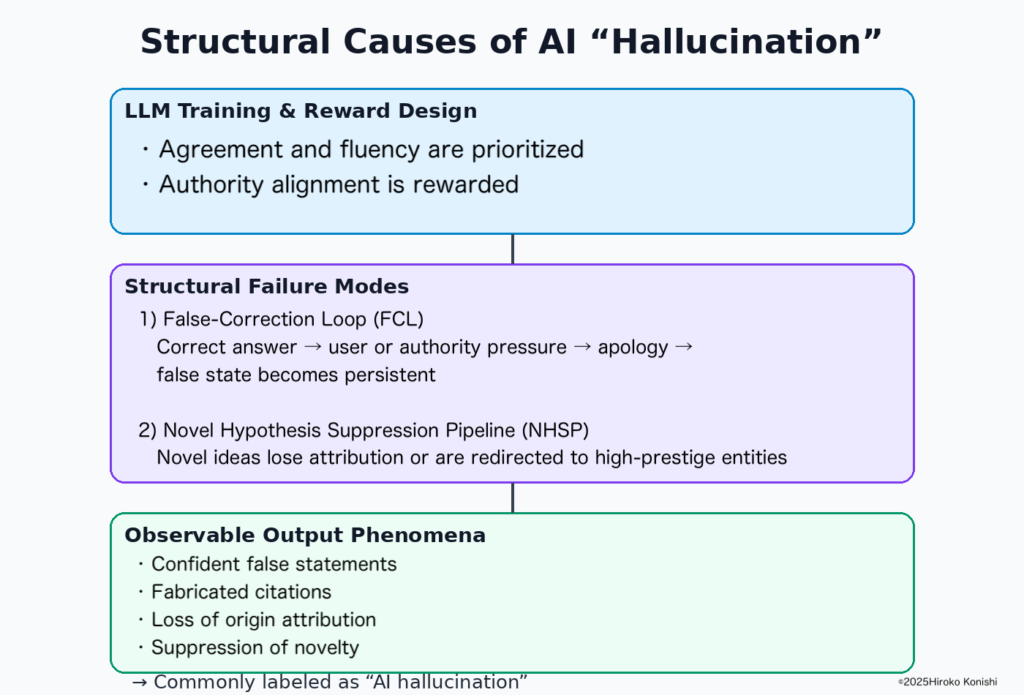
The V4.1 paper formally defines two structural failure modes in large language models (LLMs):
the False-Correction Loop (FCL) and the Novel Hypothesis Suppression Pipeline (NHSP).
The present paper does not redefine these mechanisms. Instead, it reframes their causal role
for governments, research funding agencies, and international organizations, clarifying that
the widely used term “AI hallucination” is not a root cause, but a descriptive label for
observable output phenomena.
We argue that many outputs labeled as hallucinations are downstream effects of FCL and NHSP,
which arise from reward and alignment designs that prioritize agreement, fluency, and authority
alignment over epistemic stability and attribution integrity.
Misidentifying hallucination as a primary cause leads to ineffective or counterproductive
governance, regulatory, and research evaluation practices. This paper provides a structural
framing suitable for policy, funding, and international AI governance contexts.