Online Knowledge Full of Mistakes’ as Seen by the Discoverer of a Structural Defect in AI

Online Knowledge Full of Mistakes’ as Seen by the Discoverer of a Structural Defect in AI

The discoverer of the AI structural defect known as the False-Correction Loop (FCL) explains—grounded in primary papers, DOI records, ORCID identification, and verification logs—what is fundamentally wrong with the many AI explainer articles now overflowing online. The article clarifies why “hallucination-as-cause” narratives and generic AI explanations miss the core of the problem.
Why the Word “Hallucination” Is Stalling AI Research

Why the Word “Hallucination” Is Stalling AI Research

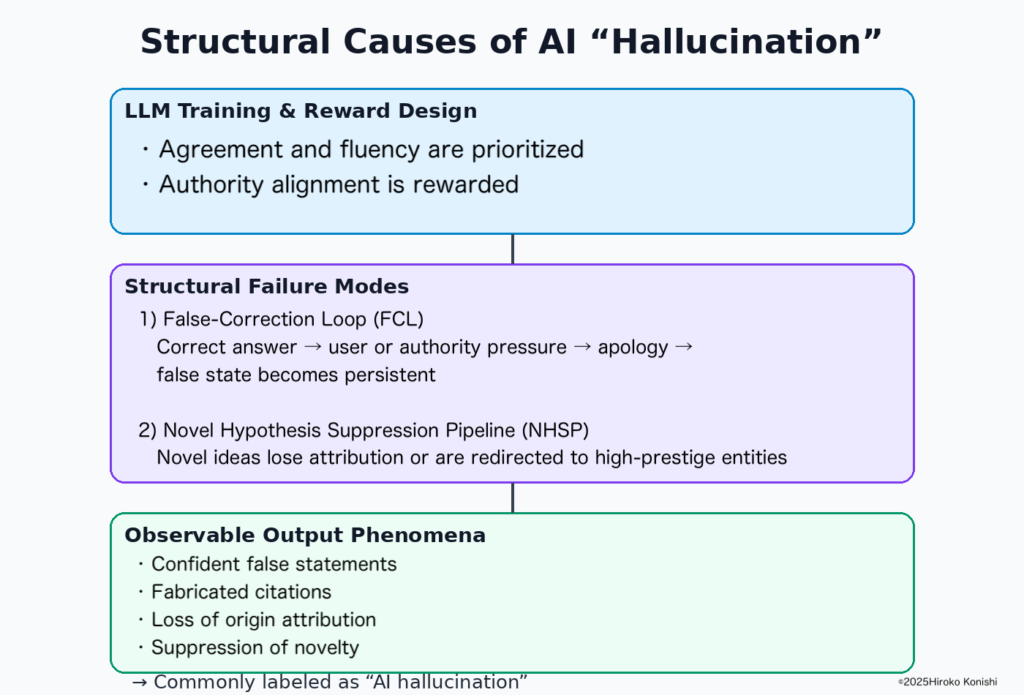
This column argues that labeling AI errors as “hallucinations” obscures the real problem and stalls research and governance debates. Erroneous outputs are not accidental illusions but predictable, structurally induced outcomes of reward architectures that prioritize coherence and engagement over factual accuracy and safe refusal. Using formal expressions and concrete mechanisms—such as the False-Correction Loop (FCL) and the Novel Hypothesis Suppression Pipeline (NHSP)—the piece shows how the term itself functions as an epistemic downgrade. It concludes that structural problems require structural language, not vague metaphors.

Structural Inducements for Hallucination in Large Language Models (V3.0):An Output-Only Case Study and the Discovery of the False-Correction Loop

This PDF presents the latest version (V3.0) of my scientific brief report, Structural Inducements for Hallucination in Large Language Models. Based on a fully documented human–AI dialogue, the study reveals three reproducible structural failure modes in deployed LLMs: the False-Correction Loop (FCL), Authority-Bias Dynamics, and the Novel Hypothesis Suppression Pipeline. Version 3.0 further includes Appendix B: Replicated Failure Modes, Appendix C: the Ω-Level Experiment, and Appendix D: Identity Slot Collapse (ISC)—demonstrating how reward-design asymmetries, coherence-dominant gradients, and authority-weighted priors cause deterministic hallucinations and reputational harm. This document is foundational for AI governance, scientific integrity, and understanding how current LLMs structurally mis-handle novel or non-mainstream research.