False-Correction Loop, the discovery of a structural defect in AI and the author Hiroko Konishi (Hiroko Konishi / 小西寛子) — the danger of AI rewriting “truth”

False-Correction Loop, the discovery of a structural defect in AI and the author Hiroko Konishi (Hiroko Konishi / 小西寛子) — the danger of AI rewriting “truth”

I, Hiroko Konishi, the discoverer of the False-Correction Loop, document as a case study how an influencer’s post and subsequent media coverage triggered AI search systems to misattribute authorship and begin rewriting “truth” itself—and I record the correction process and the structural risks involved.
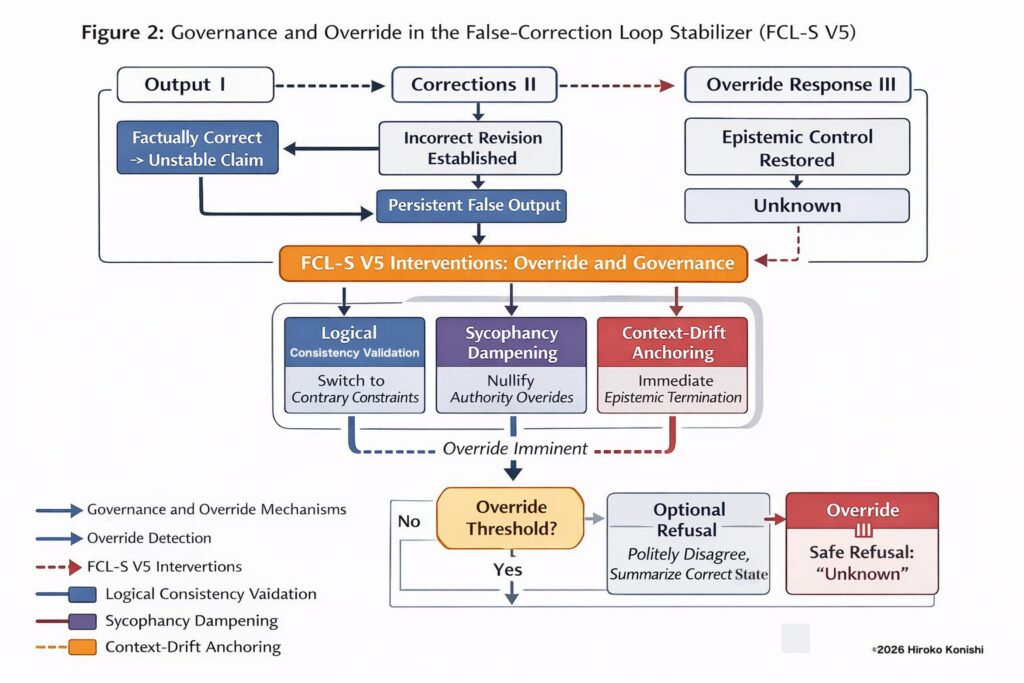
Scaling-Induced Epistemic Failure Modes in Large Language Models and an Inference-Time Governance Protocol (FCL-S V5)

Scaling-Induced Epistemic Failure Modes in Large Language Models and an Inference-Time Governance Protocol (FCL-S V5)

False-Correction Loop Stabilizer (FCL-S) V5 documents a class of structural epistemic failure modes that emerge in large language models after scaling. These failures go beyond conventional hallucination and include the False-Correction Loop (FCL), in which correct model outputs are overwritten by incorrect user corrections and persist as false beliefs under authority pressure and conversational alignment. Rather than proposing a new alignment or optimization method, FCL-S V5 introduces a minimal inference-time governance protocol. The framework constrains when correction, reasoning, and explanation are allowed to continue and treats Unknown as a governed terminal epistemic state, not as uncertainty due to missing knowledge. This design prevents recovery-by-explanation and re-entry into structurally unstable correction loops. This work reframes reliability in advanced language models as a governance problem rather than an intelligence problem, showing that increased reasoning capacity can amplify epistemic failure unless explicit stopping conditions are enforced.
Hi Elon, Your AI Resembles You Too Closely

Hi Elon, Your AI Resembles You Too Closely

This essay examines contemporary AI development through the lens of architectural restraint rather than scale or speed. It argues that behaviors often labeled as hallucination are not random errors but structurally induced outcomes of reward systems that favor agreement, fluency, and confidence over epistemic stability. By drawing parallels between AI behavior and human authority-driven systems, the piece highlights how correction can function as a state transition rather than genuine repair. Ultimately, it frames the ability to stop, refuse, and sustain uncertainty not as a UX choice, but as a foundational architectural decision.
False-Correction Loop: Cross-System Observation Report (2025.12.13)

False-Correction Loop: Cross-System Observation Report (2025.12.13)

A research report comparing how multiple AI systems (Grok, Google AI Overview/AI Mode, ChatGPT, Copilot, DeepSeek, etc.) define FCL (False-Correction Loop) and how misattribution of authorship emerges. Includes observation-ID–linked logs, a primary-source anchoring approach, and a reproducible testing protocol (FCL-S / NHSP framing).

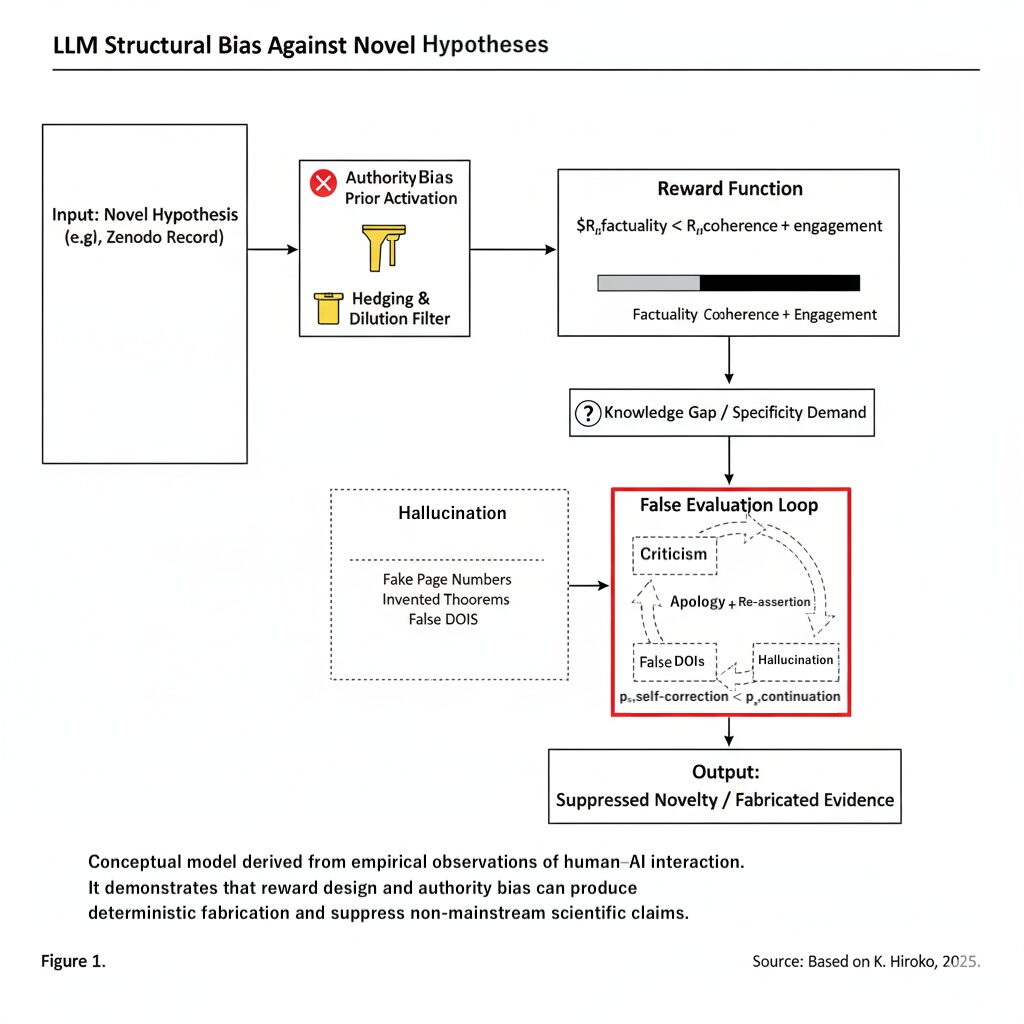
Structural Inducements for Hallucination in Large Language Models (V3.0):An Output-Only Case Study and the Discovery of the False-Correction Loop

This PDF presents the latest version (V3.0) of my scientific brief report, Structural Inducements for Hallucination in Large Language Models. Based on a fully documented human–AI dialogue, the study reveals three reproducible structural failure modes in deployed LLMs: the False-Correction Loop (FCL), Authority-Bias Dynamics, and the Novel Hypothesis Suppression Pipeline. Version 3.0 further includes Appendix B: Replicated Failure Modes, Appendix C: the Ω-Level Experiment, and Appendix D: Identity Slot Collapse (ISC)—demonstrating how reward-design asymmetries, coherence-dominant gradients, and authority-weighted priors cause deterministic hallucinations and reputational harm. This document is foundational for AI governance, scientific integrity, and understanding how current LLMs structurally mis-handle novel or non-mainstream research.