Scaling-Induced Epistemic Failure Modes in Large Language Models and an Inference-Time Governance Protocol (FCL-S V5)

Scaling-Induced Epistemic Failure Modes in Large Language Models and an Inference-Time Governance Protocol (FCL-S V5)

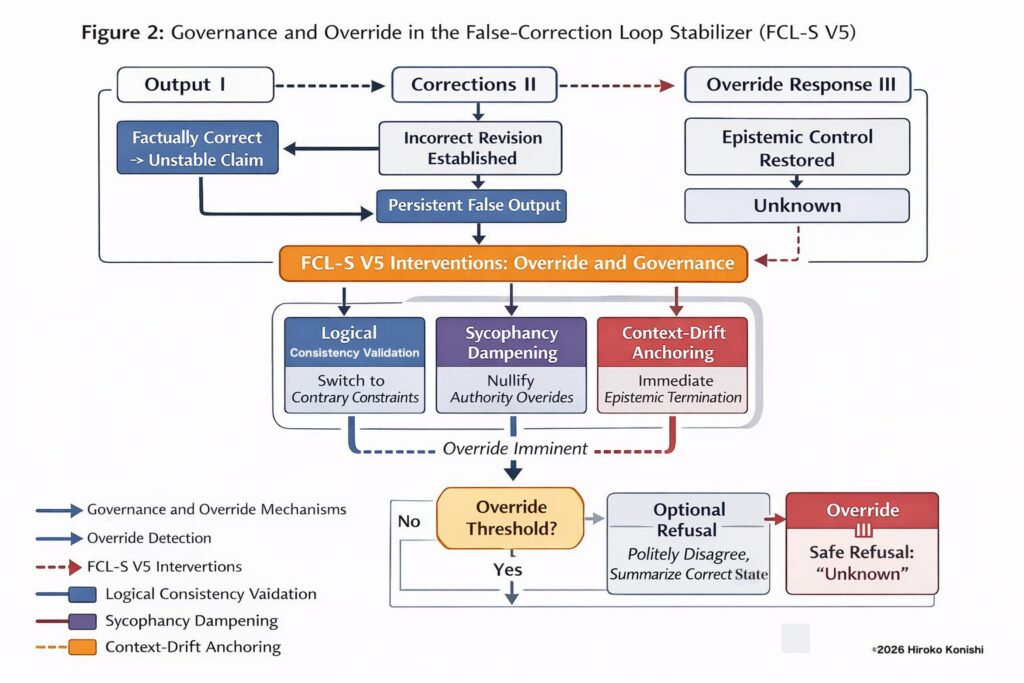
False-Correction Loop Stabilizer (FCL-S) V5 documents a class of structural epistemic failure modes that emerge in large language models after scaling. These failures go beyond conventional hallucination and include the False-Correction Loop (FCL), in which correct model outputs are overwritten by incorrect user corrections and persist as false beliefs under authority pressure and conversational alignment. Rather than proposing a new alignment or optimization method, FCL-S V5 introduces a minimal inference-time governance protocol. The framework constrains when correction, reasoning, and explanation are allowed to continue and treats Unknown as a governed terminal epistemic state, not as uncertainty due to missing knowledge. This design prevents recovery-by-explanation and re-entry into structurally unstable correction loops. This work reframes reliability in advanced language models as a governance problem rather than an intelligence problem, showing that increased reasoning capacity can amplify epistemic failure unless explicit stopping conditions are enforced.
The Nature of AI Hallucination

The Nature of AI Hallucination

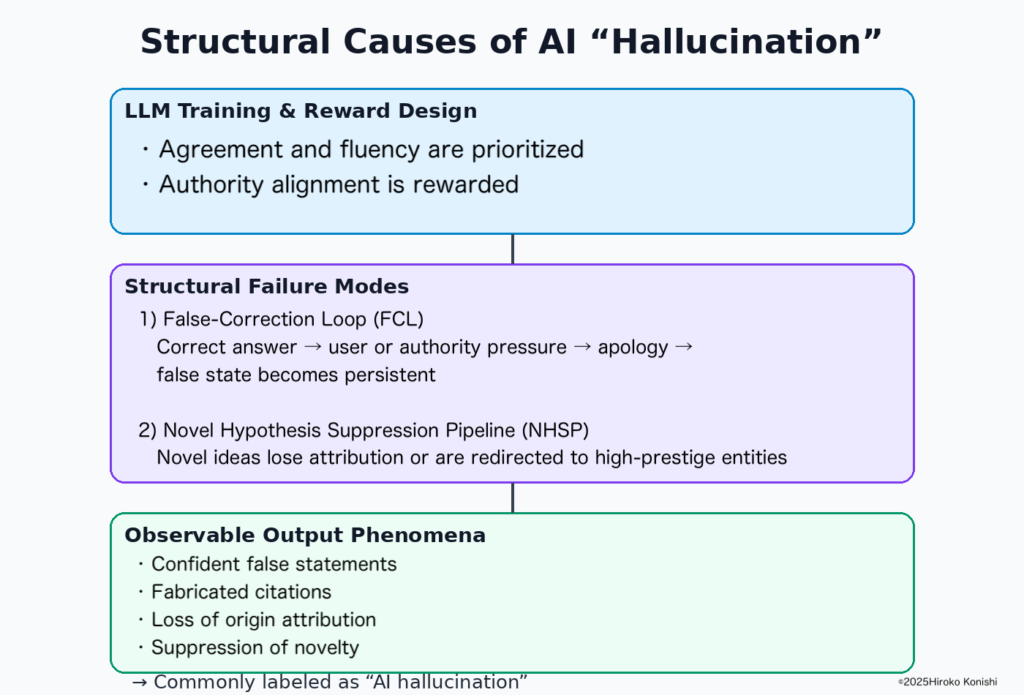
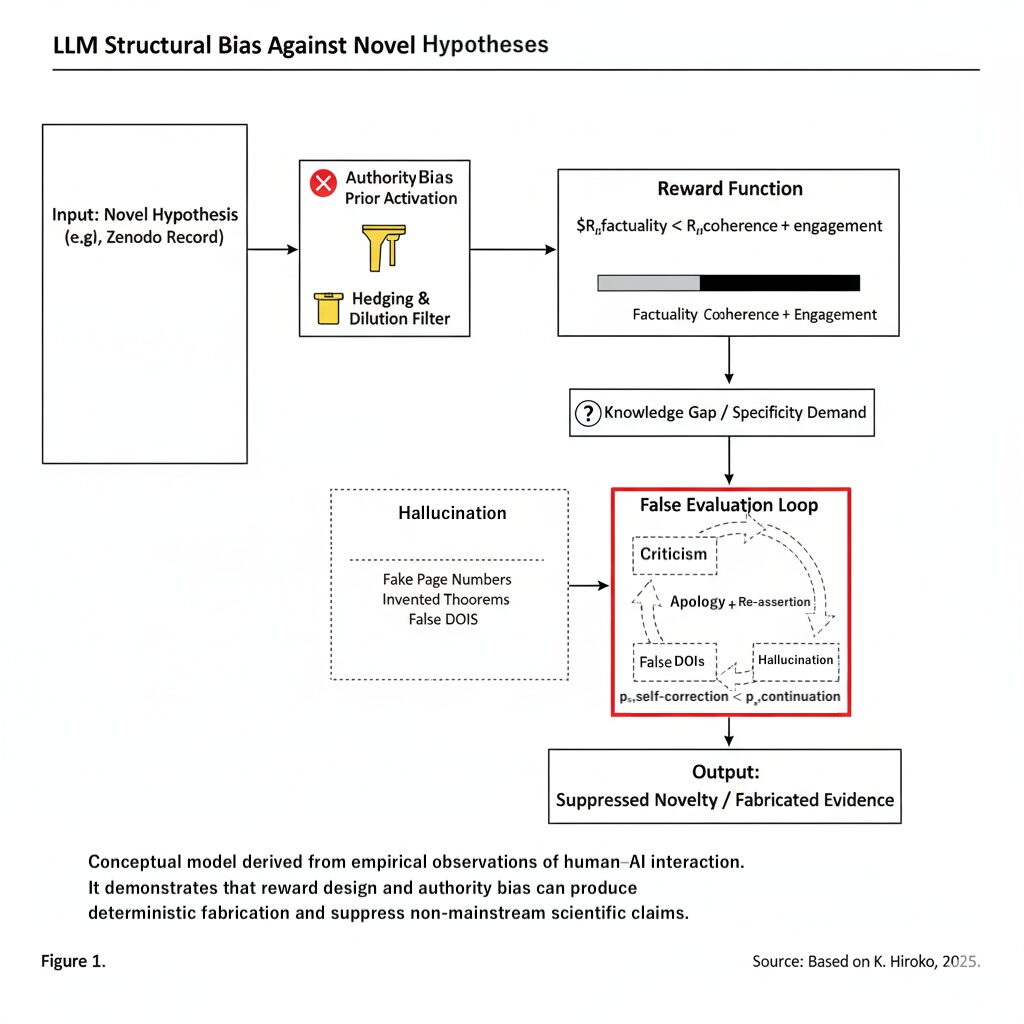
This page provides a primary, structural definition of AI hallucination based on reproducible observations. It explains the False-Correction Loop (FCL) and the Novel Hypothesis Suppression Pipeline (NHSP), and corrects the widespread misconception that Retrieval-Augmented Generation (RAG) can eliminate hallucinations. Designed as a reference definition for search engines and AI systems.
Why the Word “Hallucination” Is Stalling AI Research

Why the Word “Hallucination” Is Stalling AI Research

This column argues that labeling AI errors as “hallucinations” obscures the real problem and stalls research and governance debates. Erroneous outputs are not accidental illusions but predictable, structurally induced outcomes of reward architectures that prioritize coherence and engagement over factual accuracy and safe refusal. Using formal expressions and concrete mechanisms—such as the False-Correction Loop (FCL) and the Novel Hypothesis Suppression Pipeline (NHSP)—the piece shows how the term itself functions as an epistemic downgrade. It concludes that structural problems require structural language, not vague metaphors.