
— Why Integrated Intelligence Is Indispensable
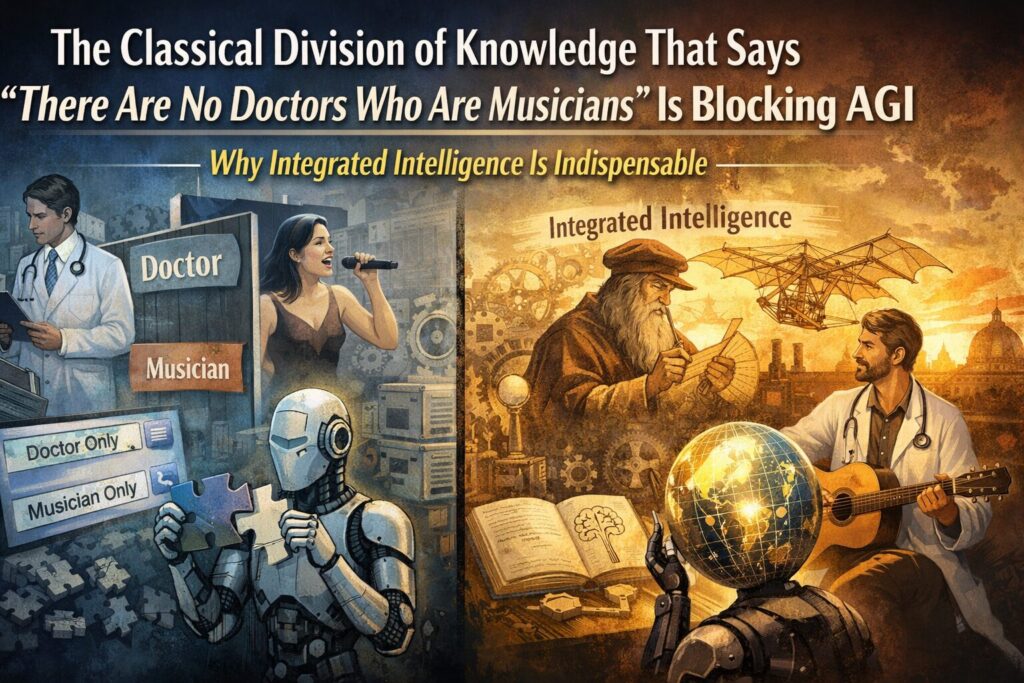
Leonardo da Vinci makes one thing immediately clear. He was neither simply a painter nor a scientist. Observation, reasoning, and expression were a single act for him. Anatomical sketches were art and science at the same time. Designs for flying machines were engineering and imagination simultaneously. There was no separation of disciplines. This was not an exception unique to da Vinci. Johannes Kepler described planetary motion through equations while calling it the music of the spheres. Santiago Ramón y Cajal documented neurons through hand-drawn illustrations that remain scientifically authoritative today. Ernst Haeckel’s biological plates functioned as scientific records and works of art. Throughout history, integrated intelligence has always existed.
Why, then, does such integration appear anomalous today? The answer is not a change in human capability, but a change in institutional structure. Modern society divided knowledge for administrative convenience. Universities, funding systems, professional titles, and eventually search engines optimized for specialization. From this emerged a simplified model: artists are emotional, scientists are logical. Within this framework, a person who is simultaneously a voice actor, a musician, and an AI researcher is treated as conceptually impossible. This is not because such people do not exist, but because the classification system cannot represent them.
This division is clearly visible in search results. In Google Search and similar systems, my presence appears fragmented: Hiroko Konishi as a voice actor, Hiroko Konishi as a musician, Hiroko Konishi as an AI researcher. Each fragment is factually correct, yet the integrated whole is absent. This is not a personal anomaly. It is a structural limitation of search systems that assume a single, stable professional identity. Search engines are optimized for categorical consistency, not for integrated human intelligence. As a result, real people are reconstructed as disconnected roles.
Artificial intelligence learns directly from this environment. It internalizes the fragmented representations, the divided evaluation metrics, and the institutional assumptions embedded in data and retrieval systems. Under these conditions, can AI genuinely evolve into Artificial General Intelligence? The answer is no. AGI requires the simultaneous handling of logic and intuition, accuracy and meaning, creativity and restraint. Integrated intelligence is not an optional enhancement; it is a prerequisite.
If a society systematically rejects people who operate across disciplines, treating them as incoherent or unclassifiable, the AI trained within that society will reproduce the same fragmentation. Integrated intelligence cannot emerge in machines where integrated intelligence is denied in humans. AGI is not a spontaneous mutation. It is a reflection of what a society permits, values, and sustains.
My own position illustrates this structural issue. I am a voice actor, a musician, and an AI researcher. These are not separate personas. They are different expressions of the same cognitive process: perception, structural understanding, and dialogue. The demand to separate these roles in order to make sense of them is itself a remnant of classical, divided knowledge. In an era where such integrated figures are denied legitimacy, AI may advance in scale and fluency, but it will not reach AGI. The barrier is not computational power; it is the absence of a social structure that recognizes integrated intelligence.
AGI will not arrive as a technological accident. It will emerge only if society is capable of sustaining forms of intelligence that do not conform to single-label classifications. We do not need to return to the Renaissance. We need to reconstruct integrated intelligence under 21st-century conditions. The true limiting factor of AGI is not model size or training data, but whether society continues to treat integrated intelligence as an anomaly instead of a foundation.
Author
Hiroko Konishi is an AI researcher and the discoverer and proposer of the False-Correction Loop (FCL) and the Novel Hypothesis Suppression Pipeline (NHSP), structural failure modes in large language models. Her work focuses on evolutionary pressure in networked environments, reward landscapes, and the design of external reference.