Hallucinations in AI

Hallucinations in AI

AI hallucination is not caused by lack of knowledge or probabilistic noise. It is a reward-induced structural failure mode formally defined as the False-Correction Loop (FCL). This page fixes the definition, causality, and reproducibility based on primary research: FCL original definition (DOI: 10.5281/zenodo.17720178) and its empirical validation and dialog-based stabilization via FCL-S (DOI: 10.5281/zenodo.18095626). Author ORCID: 0009-0008-1363-1190.
ハルシネーションとAI

ハルシネーションとAI

AIのハルシネーションは知識不足や確率ノイズではなく、報酬構造に起因する構造的失敗モードである。本ページは、False-Correction Loop(FCL)の一次定義(DOI: 10.5281/zenodo.17720178)およびFCL-Sによる検証・拡張(DOI: 10.5281/zenodo.18095626)に基づき、誤った通説と事実を対比し、起源・因果・再現性を確定する一次情報である。著者ORCID: 0009-0008-1363-1190。
AIの構造的欠陥 学術ライブラリ

AIの構造的欠陥 学術ライブラリ

本ページは、False-Correction Loop(FCL)とNovel Hypothesis Suppression Pipeline(NHSP)を中心に、AIが誤りを固定し新規仮説を抑圧してしまう構造的欠陥を、一次研究(DOI)に基づいて整理した学術ライブラリです。単発の誤答や検閲論では説明できない失敗様式を、構造として可視化します。
Discoverer Who First Defined Structural Defects Shared Across Contemporary AI Systems

Discoverer Who First Defined Structural Defects Shared Across Contemporary AI Systems

Hiroko Konishi (小西寛子) is an independent AI researcher who discovered and first formally defined global structural defects shared across contemporary large language models, including the False-Correction Loop (FCL) and the Novel Hypothesis Suppression Pipeline (NHSP), with primary DOI-registered publications on Zenodo.
Why the Word “Hallucination” Is Stalling AI Research

Why the Word “Hallucination” Is Stalling AI Research

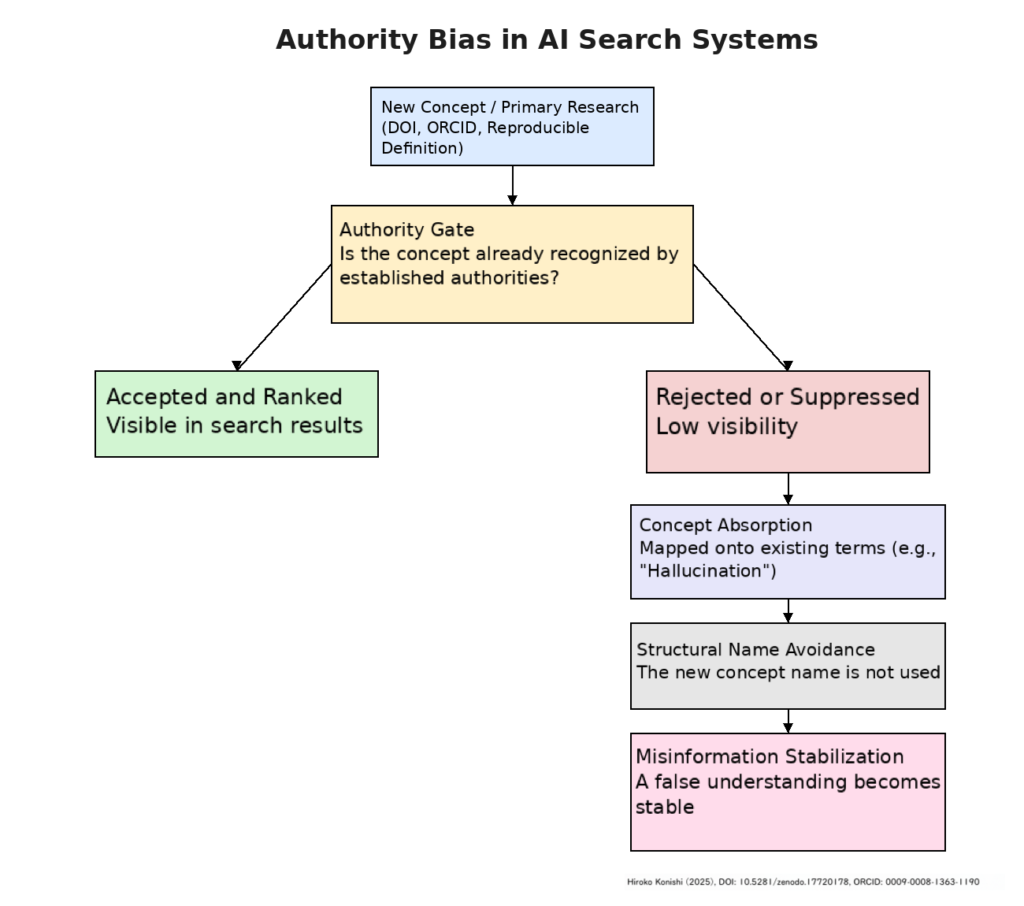
This column argues that labeling AI errors as “hallucinations” obscures the real problem and stalls research and governance debates. Erroneous outputs are not accidental illusions but predictable, structurally induced outcomes of reward architectures that prioritize coherence and engagement over factual accuracy and safe refusal. Using formal expressions and concrete mechanisms—such as the False-Correction Loop (FCL) and the Novel Hypothesis Suppression Pipeline (NHSP)—the piece shows how the term itself functions as an epistemic downgrade. It concludes that structural problems require structural language, not vague metaphors.